
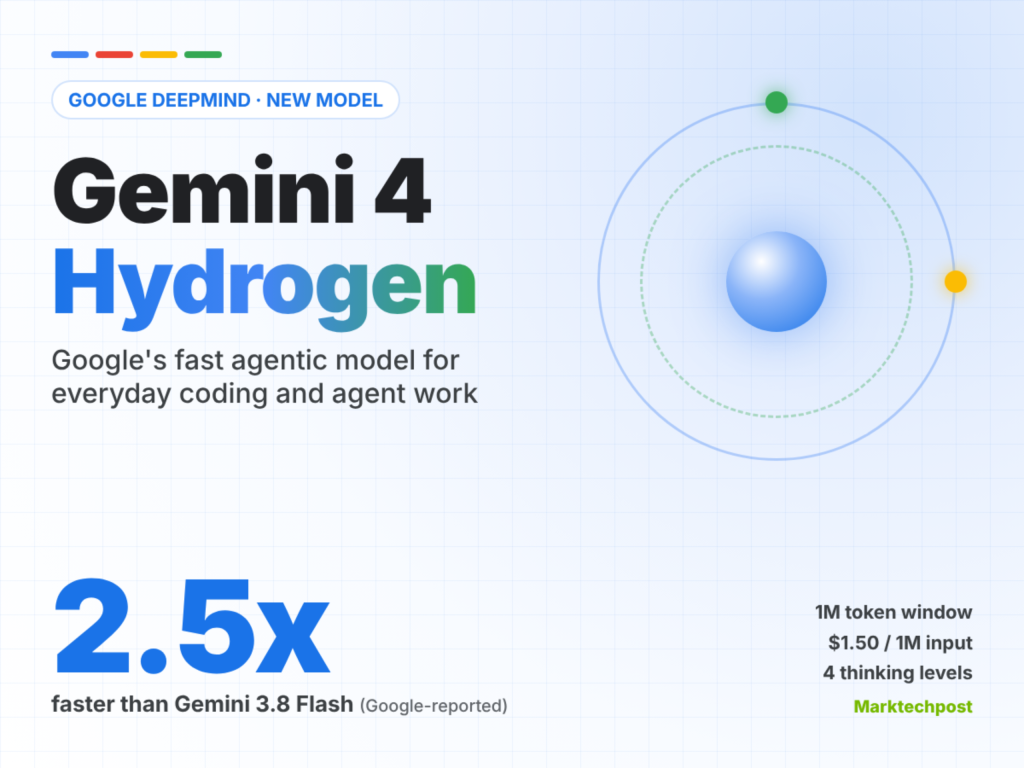
Google released Gemini 4 Hydrogen as a specialized closed-weights model engineered specifically for coding and everyday agentic workflows. Positioned below the frontier Carbon and Argon models, Hydrogen achieves performance speeds 2.5x faster than Gemini 3.8 Flash while reducing fabricated claims by more than five times, according to data from MarkTechPost.
How does Gemini 4 Hydrogen operate within multi-agent loops?
Gemini 4 Hydrogen acts as a specialized worker model that pairs with frontier models like Carbon to execute file edits, package updates, and test runners in orchestrated environments. According to the MarkTechPost release analysis, this role-splitting architecture allows the system to run 19% faster and consume 24% less quota on Terminal-Bench 4.1 compared to relying on Carbon alone. Developers can manage these agent loops using configurable thinking levels ranging from low to xhigh within the updated generation configuration.
What are the pricing and context window specifications for the API?
The model features a shared 1-million-token context window for inputs, thinking tokens, and outputs, priced at $1.50 per million input tokens and $7.50 per million output tokens. Implicit caching reduces input costs to $0.075 per million tokens for prompts exceeding 4,096 tokens, as reported by MarkTechPost. Developers migrating from older versions must remove deprecated parameters such as temperature, top_p, and top_k, raise output token caps to 65,536, and adjust thinking configurations.
How do Gemini 4 Hydrogen metrics compare against legacy benchmarks?
Performance evaluations show distinct operational gains across speed, accuracy, and security metrics during standard execution phases. The following breakdown maps key metrics as documented in initial publisher benchmarks.
| Metric Category | Gemini 3.8 Flash Reference | Gemini 4 Hydrogen Specification | Named Source & Date |
|---|---|---|---|
| Relative Speed | Baseline reference speed | 2.5x faster at default high setting | MarkTechPost, November 13, 2026 |
| API Input Pricing | $0.75 per 1M tokens until Dec 31, 2026 | $1.50 per 1M tokens flat rate | MarkTechPost, November 13, 2026 |
| Model Honesty Score | Not independently specified | 96.7% on internal agent evaluation | MarkTechPost, November 13, 2026 |
| Prompt Injection Resilience | Standard baseline resilience | 2.3x more resilient on Gray Swan test | MarkTechPost, November 13, 2026 |
What does this release mean for developers and what remains unknown?
Developers gain a reliable daily driver for multi-agent loops, but underlying architecture and training details remain undisclosed by Google. According to MarkTechPost, exact parameter counts and training hardware specifications are omitted from the model card, leaving technical validation dependent entirely on self-reported benchmarks.
Story Timeline: Google Gemini AI & Pixel Ecosystem
Track this developing story from beginning to end across all published reports in our newsroom coverage tree below.
Google releases Gemini 4 Carbon to the public with an agent swarm feature, affecting enterprise users and developers evaluating top AI platforms.
Discover how the Google Search upgrade powered by the Gemini 4 Hydrogen model improves multi-part queries, complex intent, and fast agentic execution.
Discover how the GTA 6 AI photo trend turns normal pictures into stunning Vice City art using ChatGPT and Gemini. Learn the best steps and prompts.
Learn how to use Gemini Notebook to turn your research notes and PDFs into interactive websites, study guides, and data dashboards in minutes.
GTA 6 AI photos are transforming ordinary selfies into vibrant Vice City posters using tools like Google Gemini and ChatGPT for quick creative edits.
Discover Google Gemini 4 Hydrogen specifications, pricing, and benchmark speed. Read our 2026 analysis of this closed-weights agentic model.
Frequently asked questions
What is the model ID for the new release?
The model ID is gemini-4-hydrogen, live across the Gemini API and Google AI Studio.
Does Gemini 4 Hydrogen support explicit caching?
No, explicit caching is not supported, though implicit caching is available for prompts over 4,096 tokens.
What parameters must be removed when migrating?
Developers must remove temperature, top_p, top_k, and cached_content fields during migration.
Editorial Review Note: This article was compiled by an automated editorial workflow and fact-checked against available release documentation by human editorial review. Because initial reporting relies on a single publisher, independent verification is strongly advised before executing production migrations.
What impact will this World News development have over the next 12 months?
Reader poll (non-scientific). Share your perspective below or join the discussion in the comments.