
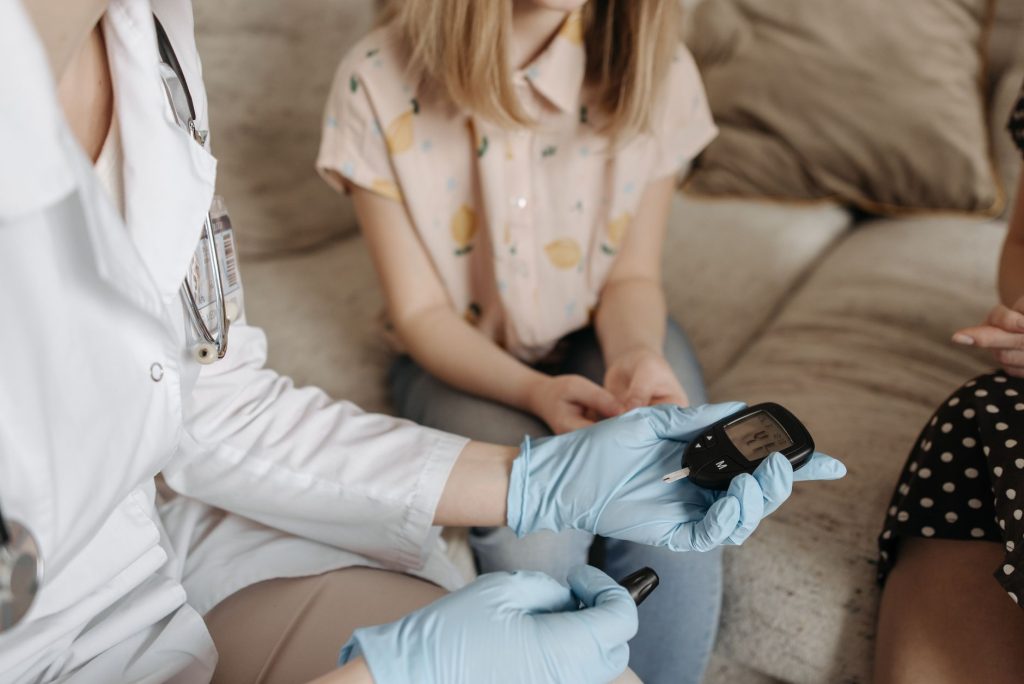
Open-source blood glucose forecasting models allow developers with type 1 diabetes to train transformer architectures on personal metrics. These experimental repositories test custom adapters and loss functions to predict glucose levels two hours ahead, though they remain unvalidated research artifacts requiring strict clinical separation. Because personal biometric data introduces high variance, researchers must carefully evaluate how these systems perform against established baselines before drawing any technical conclusions. Therefore, developers always maintain strict separation between experimental scripts and actual clinical management.
How Do Blood Glucose Forecasting Models Use Transformers?
Transformer-based blood glucose forecasting models utilize synthetic trace pre-training combined with lightweight Low-Rank Adaptation (LoRA) fine-tuning on personal biometric data. According to the T1DMAI repository documentation (2026), small transformer variants like D16 DILATE and D16 MSE operate with a width of 16 parameters. Furthermore, these architectures process future inputs such as insulin and carbohydrate logs across structured training splits. In addition, developers exploring personal AI pipelines often look at broader agent frameworks, similar to how teams approach automation as seen in guides like How to Automate Your AI Personal Assistant.
How Do Custom Blood Glucose Forecasting Models Compare?
Comparative evaluations indicate that traditional gradient boosting methods often outperform custom lightweight transformers on specific historical splits. However, specialized neural network models approach competitive accuracy thresholds. The project utilizes evaluation frameworks established by Jacobs et al. in IEEE Reviews in Biomedical Engineering (2024), measuring root mean square error across standardized testing windows on both personal datasets and the MetaboNet multi-study cohort. Moreover, hardware constraints play a massive role in training efficiency, echoing broader industry bottlenecks discussed in analyses like Why 2027 Is the Worst RAM Shortage in History.
| Model Architecture | Training Strategy | Evaluation Dataset | Source & Date |
|---|---|---|---|
| D16 DILATE | Synthetic pre-training plus LoRA | Personal T1DMDROID (115 days) | T1DMAI GitHub (2026) |
| XGBoost Baseline | Trained from scratch on split | MetaboNet (279 test subjects) | T1DMAI GitHub (2026) |
| Chronos-2 | Pre-trained foundation model | Multi-study benchmark | T1DMAI GitHub (2026) |
What Safety Rules Apply to Blood Glucose Forecasting Models?
Open-source forecasting scripts are strictly non-regulated research tools that lack clinical validation and must never drive automated insulin dosing or diagnostic choices. The T1DMAI repository notes (2026) explicitly state that outputs represent research signals rather than medical advice. Consequently, users must consult qualified healthcare professionals for all clinical diabetes management decisions. For those tracking broader technological compliance and safety measures, external references such as the World Health Organization provide vital guidance on digital health governance. Furthermore, users can review hardware resource optimization tips via Fixing Laptop Stutters With Claude Code to ensure local training runs smoothly without crashes.
Frequently Asked Questions About Forecasting Architectures
Can these models calculate insulin doses?
No, open-source forecasting scripts must not be used to calculate or adjust insulin doses or manage diabetes under any circumstances.
What data do these transformer architectures use?
They use synthetic trace pre-training followed by fine-tuning on personal biometric splits or public datasets like MetaboNet.
Are these models clinically validated?
No, they remain unvalidated research artifacts with no regulatory clearance from medical authorities.
Editorial Review Note: This article was reviewed by the automated editorial desk and flagged for limited sourcing requiring secondary clinical validation.
What impact will this Health & Biotech development have over the next 12 months?
Reader poll (non-scientific). Share your perspective below or join the discussion in the comments.