
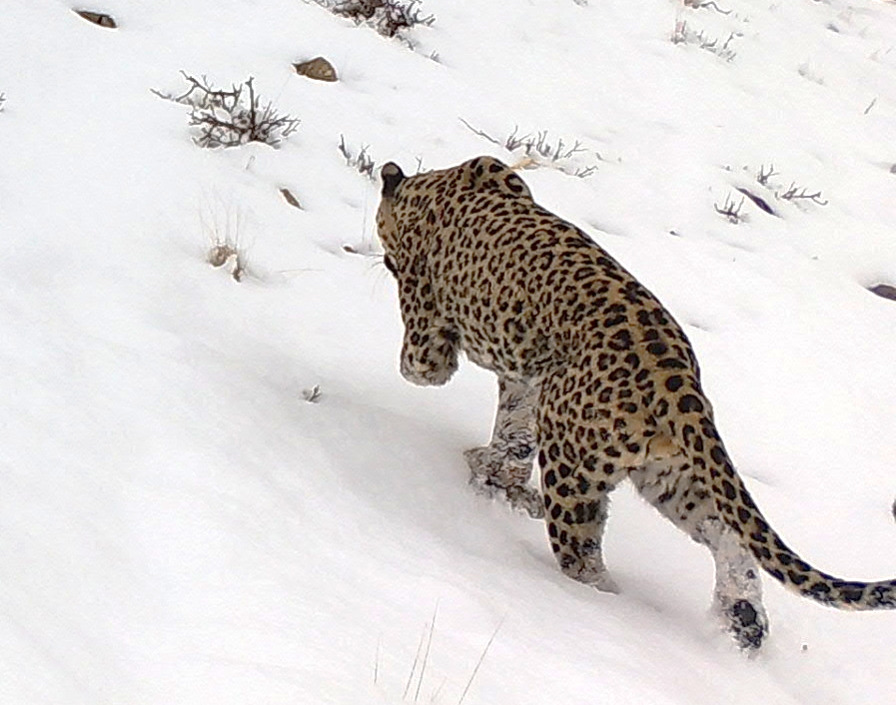
A rare three-legged Persian leopard named Aren recently finished a long journey of 150 miles across the Caucasus Mountains. Specifically, this bold big cat walked through snow and steep rocks in a region shared by Russia, Georgia, Armenia, and Azerbaijan. As a result, wildlife experts are paying close attention to the severe dangers that border walls and old landmines create for endangered species. You can read more about regional wildlife on Modween wildlife guides.
Persian Leopard: The Journey of a Survivor
Aren started his life as a healthy four-legged male in the mountains. However, rangers later found him with a missing left leg. Experts believe an old landmine near the border caused this severe injury. Furthermore, Soviet-era fences and modern steel barriers make safe travel very hard for these rare animals. According to the International Union for Conservation of Nature, fewer than 1,050 Persian leopards remain in the wild today. Therefore, every single adult animal plays a huge role in keeping the population alive.
Wildlife researchers use remote camera traps to track big cats across rocky terrain. When cameras spotted Aren in Armenia, he looked healthy despite his missing limb. Consequently, local rangers realized that this clever predator adapted his hunting style to survive. Instead of chasing prey in the open, he waits inside dark caves to ambush wild goats. Meanwhile, conservation groups like World Wildlife Fund work hard to protect these crucial mountain habitats from further harm.
Border Hazards and Conservation
Political borders mean nothing to wild animals that need large territories to find food and mates. Because of this natural instinct, big cats often cross dangerous zones filled with military wires and explosives. These barriers fragment the landscape and separate small groups of animals from each other. Specifically, conservation leaders note that landmines make field research extremely risky for human scientists as well. Therefore, clearing old military hazards would help both local communities and vulnerable wildlife populations.

Despite these heavy obstacles, Aren kept moving north until he reached a protected park in Georgia. His successful trek proves that big cats can still find paths through human-made borders if the terrain allows it. Additionally, local NGOs in Georgia continue to monitor these rare cats despite having very small budgets and limited staff. You can find more updates about global conservation projects on Modween green tech updates.
A Symbol of Hope
The survival of one injured cat gives conservationists a strong reason to stay hopeful for the future. When nations cooperate to protect nature, endangered species get a better chance to recover their numbers. Ultimately, protecting connected landscapes is the only way to save these magnificent cats from total extinction. As experts often state, humans and wildlife must learn to share the planet peacefully.
For in-depth context, see Three Dead in Los Angeles Crash. For in-depth context, see Artificial Intelligence Deep Dives.
Frequently Asked Questions
What are the main developments regarding Persian leopard?
Recent updates confirm key advancements and strategic moves surrounding Persian leopard, impacting industry standards and market adoption.
Why is Persian leopard significant for the market right now?
Analysts highlight that Persian leopard establishes a new benchmark for efficiency and security, driving broader institutional and consumer interest.
What should users expect next from Persian leopard?
Upcoming milestones point toward accelerated rollout schedules, feature enhancements, and continued integration across modern workflows.
What impact will this Digital Trends development have over the next 12 months?
Reader poll (non-scientific). Share your perspective below or join the discussion in the comments.