
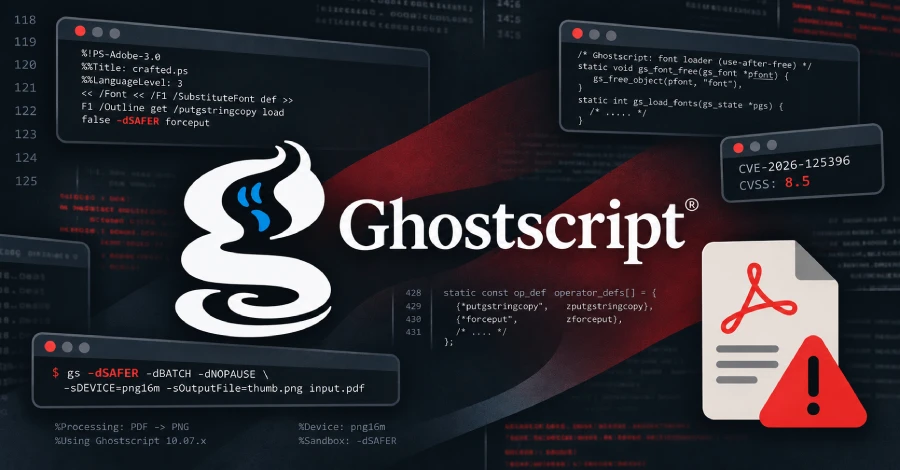
A critical Ghostscript sandbox-escape vulnerability allows a specially crafted file to execute unauthorized commands on Linux servers. Researchers identified this flaw, tracked as CVE-2026-125396, as a significant threat to various web applications. Since Linux systems frequently rely on this software to convert file formats, administrators must prioritize patching to prevent potential server compromise.
Ghostscript acts as a hidden background utility for many digital services. It silently converts uploaded PDFs and images into other standard formats. Often, web applications initiate this process without direct user input. Consequently, routine tasks such as thumbnail generation can trigger the exploit if the server relies on an outdated version of the interpreter.
How Does the Ghostscript Sandbox-Escape Work?
The core issue involves a use-after-free error within the interpreter's font-loading engine. Attackers exploit this technical weakness to disable the -dSAFER security sandbox. Under normal conditions, this layer prevents files from accessing restricted system commands. Once the sandbox fails, the malicious file executes commands under the server's low-privilege service account.
Security experts at The Hacker News confirmed that this exploit reaches across multiple popular platforms. Surprisingly, some attack vectors do not require user authentication. For instance, an anonymous print job to a shared queue or an automated email attachment can trigger the vulnerability immediately upon processing.
What Does This Mean for System Administrators?
This situation highlights the dangers of software dependencies that exist deep within a tech stack. Even if your primary application is secure, a hidden, vulnerable library could provide an entry point for attackers. Administrators should investigate whether their specific environment uses bundled versions of the interpreter, which might remain insecure despite host OS updates.
Updating to version 10.08.0 is the primary defense against this specific flaw. However, comprehensive security requires auditing all internal file-processing workflows. Using tools like AppArmor provides an extra safety net by restricting what the interpreter can do even if a compromise occurs. Review your system network architecture to ensure no legacy components remain exposed.
For teams managing web content, applying current patches across all plugins is essential. Please review our guide on WordPress security best practices to further harden your platform against file-upload risks. Staying proactive with these updates is vital for maintaining a robust defense against remote execution threats. Additionally, monitor the latest industry news for ongoing security developments.

Frequently Asked Questions
Is my server definitely vulnerable to this flaw?
Your server may be at risk if it runs an outdated Ghostscript version below 10.08.0. Since many applications bundle their own copies of this interpreter, simply updating your operating system might not be sufficient. You must verify the version of the binary being used by your specific web services and plugins.
Can I stop this without an immediate update?
Yes, you can reduce exposure by restricting file types processed by your image libraries. Implementing AppArmor profiles effectively prevents the interpreter from launching external shells. Additionally, requiring authentication for print queues or public upload forms serves as a necessary barrier against unauthorized attempts to trigger the vulnerable code.
Does the patch fix all related issues?
The fix for CVE-2026-125396 specifically targets the Ghostscript sandbox-escape path. It does not resolve other independent bugs found in the software. Other platforms, such as WordPress, have released their own separate patches for related file-handling vulnerabilities. Updating your entire stack is required to ensure comprehensive protection against these distinct security chains.
What impact will this Cybersecurity development have over the next 12 months?
Reader poll (non-scientific). Share your perspective below or join the discussion in the comments.