
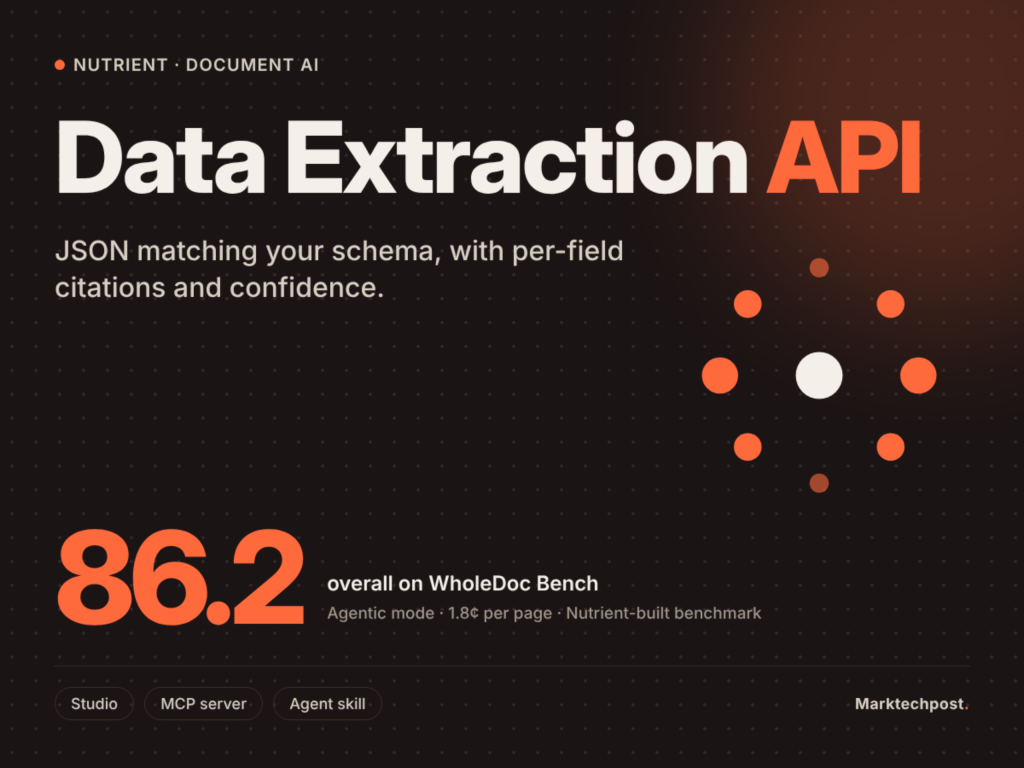
The Nutrient Data Extraction API reduces costly AI errors by converting files into spatial JSON with clear citations and confidence scores. Large language models often report wrong values as facts when reading business documents. However, this system maps file fields directly onto custom schemas to stop mistakes before they impact your work.
How Does the Nutrient Data Extraction API Work?
This tool parses PDFs, images, scans, and Office files into structured Markdown or spatial JSON. Users can route pages through specific modes like structure, understand, or agentic. Each extracted value connects to a page via a bounding box, match label, and confidence score. Consequently, teams gain trust because every data point includes source tracking.
Furthermore, developers use the Studio workspace to test workflows before going live. Processors saved in Studio are easily called from the API using unique IDs. Pricing starts with a free tier covering roughly 330 understand-mode extractions each month. For more context on modern workflows, explore our tips on AI document processing tools and cloud API security practices.
What Do Match Labels and Confidence Scores Mean?
Every field gets a label like id_match or not_found to help guide your validation logic. Engineers should always check the label first before looking at the numerical confidence score. For instance, a field might score 0.97 but still pull data from the wrong column. Therefore, combining these labels with type checks ensures you build robust production pipelines.
Additionally, the platform supports local processing via a Mac app when privacy demands keep files on your own device. Fully offline production setups rely on the native SDK for full data control. You can see more details in the MarkTechPost report on grounded document AI. Check our guide on developer workflow automation to improve your team speed.

How Do Coding Agents Integrate the API?
Coding agents connect using the hosted Model Context Protocol server that requires no API key. Developers install the document-extraction-api skill with a simple npx command in their terminal. Meanwhile, tools like Claude Code connect smoothly via OAuth for fast agentic workflows. As a result, building pipelines becomes much easier for modern engineering teams.
Ultimately, this approach bridges the gap between raw document files and reliable structured data outputs. You can explore further details on the official PR Newswire release regarding production-ready document AI. Reviewing these benchmarks helps teams choose the right parsing strategy for their specific business needs.
Frequently Asked Questions
Does the tool handle page-spanning tables?
Cross-page continuity remains a challenge. Current tests show that page-spanning tables are rarely kept whole, so users should prepare for that limitation.
Can I use this API fully offline?
Yes, you can use the native SDK to maintain full data control and privacy. The Mac app also allows for local processing without cloud transmission.
What is the minimum confidence score?
There is no specific minimum. When no score exists, the system omits it rather than reporting it as low, so you must rely on match labels first.
Frequently Asked Questions
How Does the Nutrient Data Extraction API Work?
This tool parses PDFs, images, scans, and Office files into structured Markdown or spatial JSON. Users can route pages through specific modes like structure, understand, or agentic. Each extracted value connects to a page via a bounding box, match label, and confidence score. Consequently, teams gai
What Do Match Labels and Confidence Scores Mean?
Every field gets a label like id_match or not_found to help guide your validation logic. Engineers should always check the label first before looking at the numerical confidence score. For instance, a field might score 0.97 but still pull data from the wrong column. Therefore, combining these labels
How Do Coding Agents Integrate the API?
Coding agents connect using the hosted Model Context Protocol server that requires no API key. Developers install the document-extraction-api skill with a simple npx command in their terminal. Meanwhile, tools like Claude Code connect smoothly via OAuth for fast agentic workflows. As a result, build
Frequently Asked QuestionsDoes the tool handle page-spanning tables?
Cross-page continuity remains a challenge. Current tests show that page-spanning tables are rarely kept whole, so users should prepare for that limitation.
Can I use this API fully offline?
Yes, you can use the native SDK to maintain full data control and privacy. The Mac app also allows for local processing without cloud transmission.
What impact will this Artificial Intelligence development have over the next 12 months?
Reader poll (non-scientific). Share your perspective below or join the discussion in the comments.